




A practical BI modernisation scenario
When companies upgrade their core ERP systems, their BI solutions must be adapted to the new IT environment. The following outlines a practical project scenario with major tasks needed to successfully transition to a new ERP-supported BI environment:
Key BI modernisation tasks during ERP transition:
- Implementation of a new BI architecture.
- Migration of existing solutions.
- Integration of the new ERP system with BI.
- Redesign of BI report visualisations.
- Formation, training, and preparation of an internal BI team.
- Development of user roles, permissions, and policies.
- Provision of licensing, infrastructure, and support.
In larger corporate groups, old and new ERP systems may run in parallel. The BI architecture must therefore support:
- Operation with the old ERP system.
- Parallel operation with both old and new ERP systems.
- Operation solely with the new ERP system.
Fundamental ERP project principles
ERP replacement projects typically commence first, but this does not mean BI implementation must wait until ERP deployment concludes. Two key principles apply:
- Flexible BI strategy. The BI implementation strategy should align with the ERP project but not be dependent on it. If ERP implementation is delayed, BI work can still progress in specific branches or departments, with ERP data integrated later.
- Early team involvement. Internal BI teams should be involved from the outset to ensure control and cost-effectiveness by appropriately distributing tasks between in-house and external specialists.
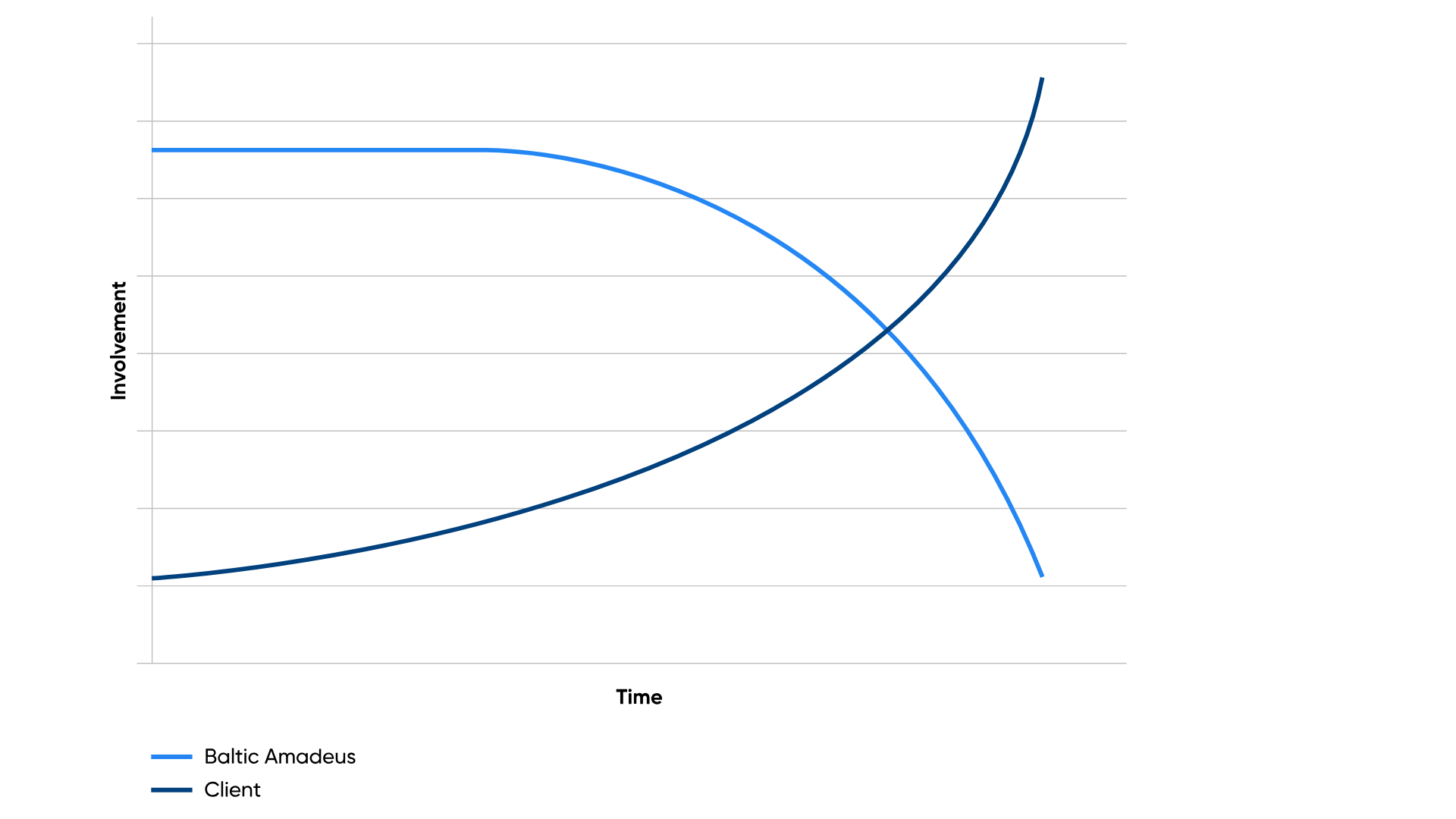
The curve reflects that the contribution of the company implementing the BI modernisation is significantly greater at the beginning of the project. However, over time, the internal team of the Client becomes increasingly involved, gaining knowledge and hands-on experience. Gradually, the implementer steps back from the role of main provider, transferring responsibility to the Client’s representatives.
Phases of BI modernisation during ERP change
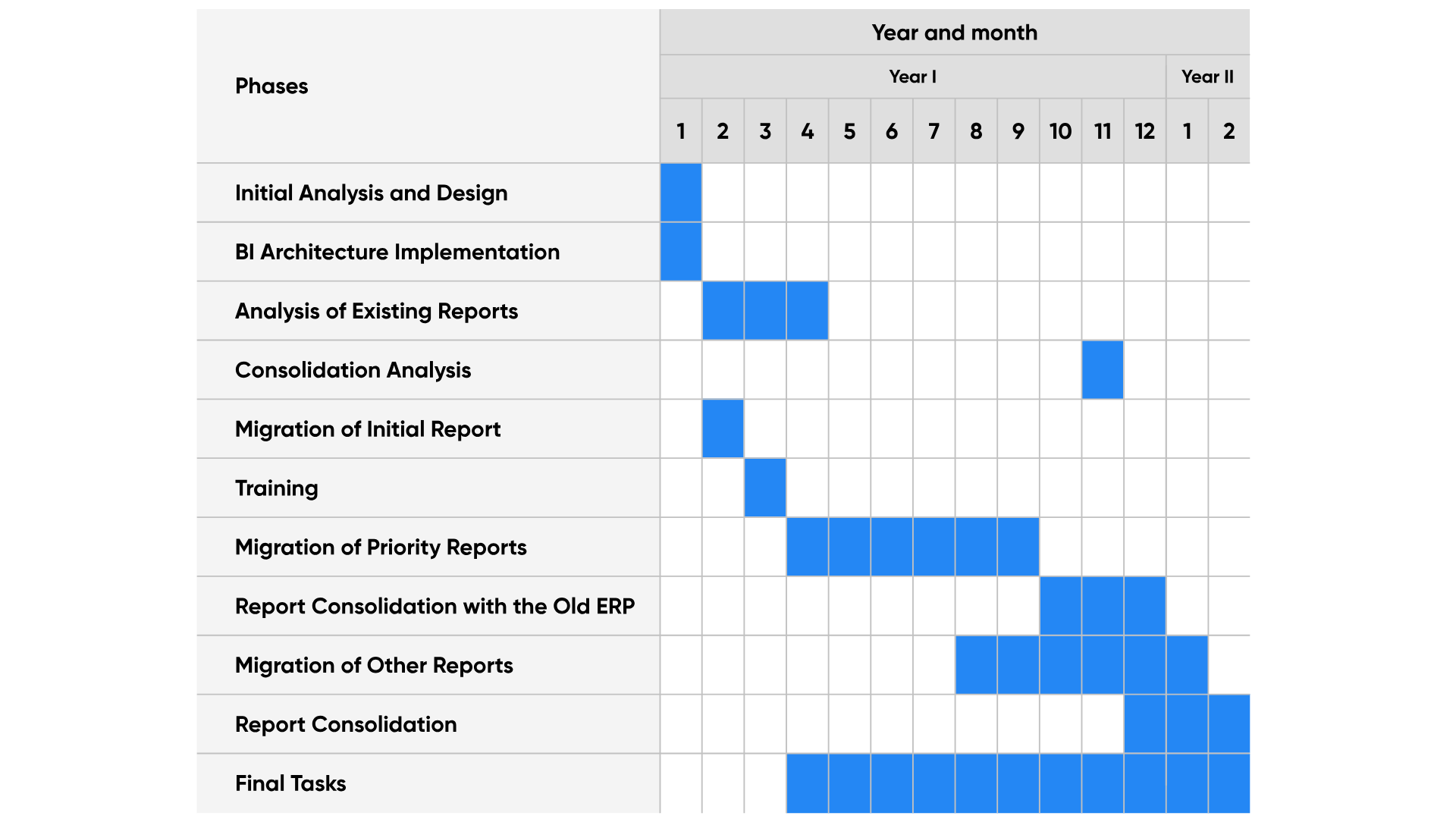
A clear and phased approach ensures a smooth transition from the current BI setup to the new system. A practical project may follow these steps:
- Initial analysis and design. We familiarise ourselves with the systems, perform data and infrastructure analysis, and prepare a detailed project plan.
- BI architecture implementation. We install and configure the platform according to the Medallion architecture concept.
- Analysis of existing reports. We conduct an analysis of the data from the old ERP system.
- Consolidation analysis. We analyse the consolidation/integration of data from both the old and new ERP systems.
- Migration of initial report. We carry out the MVP phase, during which low-priority (LOW) reports are migrated to the new BI system.
- Training. We train the Client’s internal team and provide practical knowledge. This helps to accelerate the further implementation of the solution.
- Migration of priority reports. We migrate high-priority (HIGH) reports and data from the old ERP system.
- Report consolidation with the old ERP. We integrate the new ERP data for the HIGH-priority reports with the existing ERP system.
- Migration of other reports. We migrate medium-priority (MEDIUM) reports and data from the old ERP system.
- Report consolidation. We integrate the new ERP data for the MEDIUM-priority reports with the existing ERP system.
- Final tasks. Migration, connection, and consolidation of remaining reports and data. Based on priority levels (HIGH, MEDIUM), legacy and new ERP data are connected and consolidated, and remaining reports are migrated.
Architectural vision: the Medallion model
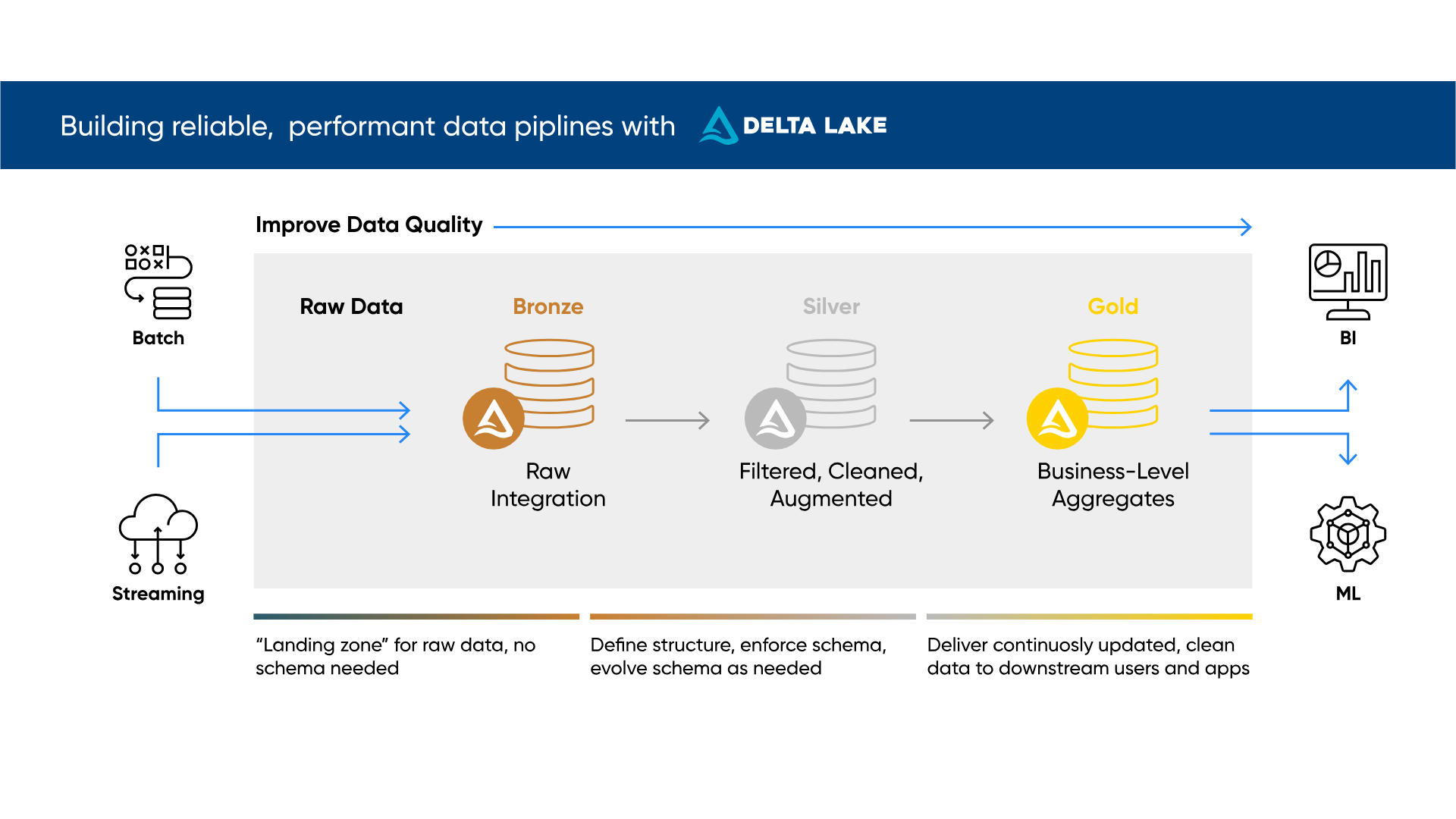
In order to transition to the Medallion architecture, it is important to emphasise that this model enables a structured and gradual improvement of data quality, as well as the expansion of the solution by integrating new data sources. The Medallion architecture helps ensure both flexibility and data quality – the key requirements for successful business analytics modernisation.
Each layer – bronze, silver, and gold – has its own specific role, which allows for a better understanding of how data is processed, analysed, and presented to the end user. Thanks to this structure, we can refer to specific models tailored to the various needs of the company – from initial data collection and processing to top-quality business analytics solutions.
Bronze layer – raw data
The bronze layer stores all data from external sources. The table structure mirrors the structure of the source systems, along with metadata columns (such as upload date, process ID, etc.).
Main advantages of this layer:
- Tracking of historical changes.
- Data lineage and auditability.
- Reprocessing of data without re-uploading from the source.
Silver layer – cleaned and harmonised data
In the silver layer, data from the bronze layer is joined, cleaned, and transformed into a unified, structured view of key business entities.
Advantages:
- Usability with self-service and advanced analytics tools
- Adaptability for the work of departmental analysts, data engineers, and data scientists
- Efficient and flexible data processing based on the ELT methodology
Gold Layer – business-ready models
In the gold layer, data is transformed into read-optimised, denormalised structures (e.g., star schema models). This layer is used for specific business analytics projects: customer segmentation, product analysis, recommendations, KPI reports.
Advantages:
- Tables prepared for consumption.
- Highest data quality and reliability.
- Ease of use for analytical applications.
The Medallion model allows for a gradual increase in data quality and the expansion of the solution by integrating new sources. Using tools such as Delta Live Tables or structured stream processing tools, it is possible to create continuously updating data streams.
Changing the ERP system in your business
The modernisation of business analytics is an integral part of an ERP replacement project. By choosing the right strategy, flexible architecture, and a competent partner, it is possible to achieve significant results: save costs, accelerate implementation, and increase the value of analytics.a=
Would you like to know what this solution could look like in your business? Get in touch with our data analytics experts and receive a free consultation!