




What is architecture?
Gartner offers two distinct definitions of architecture in the context of information technology.
The first, narrower definition describes architecture as 'the overall design of a computing system and the logical and physical interrelationships between its components, including the hardware, software, access methods, and protocols.' This definition focuses on the current or planned state of a system, essentially, what exists or what is intended.
The second definition is broader: 'a framework and a set of guidelines to build new systems, including principles, guidelines, or rules that govern the acquisition, construction, modification, and integration of IT resources within an enterprise, covering equipment, software, communications, methodologies, tools, and organisational structures.'
This broader view addresses not just what a system is, but how it is created and managed. IT leaders should adopt this comprehensive understanding, one that ties directly into the concept of the enterprise itself.
What is an enterprise?
According to The Open Group Architecture Framework (TOGAF), an enterprise is the highest-level description of an organisation. It encompasses all its missions and functions and often includes multiple organisations.
Importantly, this definition does not depend on an organisation's size or legal status. It focuses on shared goals and operations. In other words, any organisation or group with common objectives can be considered an 'enterprise.'
An enterprise is not limited to large corporations. It can be a single company division, a small, limited liability company (LLC), or even a startup team – any entity aligned around common goals qualifies.
What is Enterprise Architecture (EA)?
Enterprise architecture (EA) is an approach that enables companies to achieve their strategic goals by aligning business and IT resources. Frameworks such as Zachman, TOGAF, and DoDAF each offer their own definitions, but this is the essence.
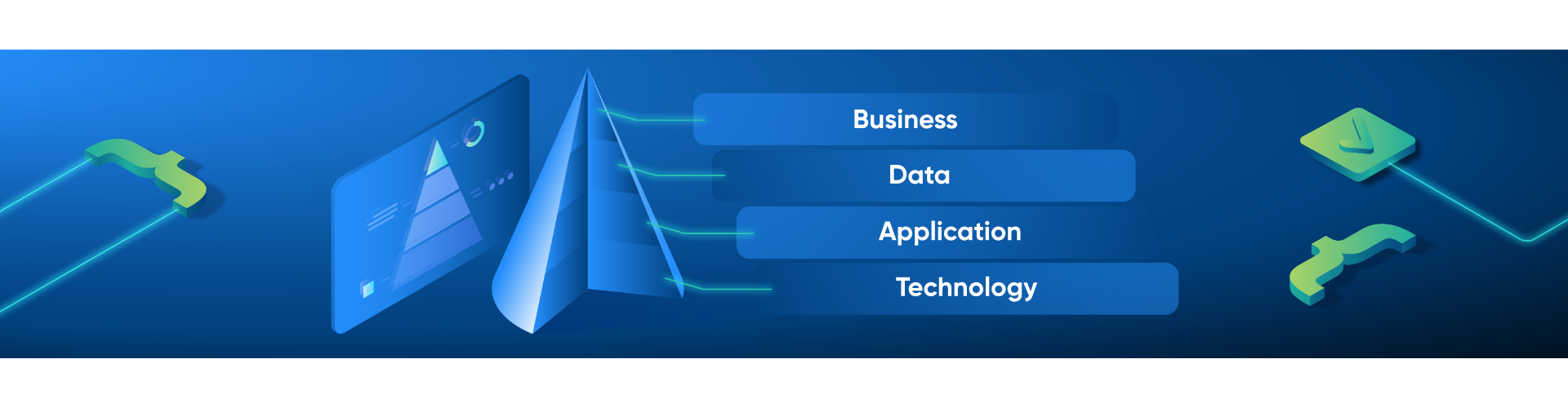
EA is typically visualised through four main domains:
- Business – the activities that drive the organisation.
- Data – information that must be managed, protected, and shared.
- Applications – software tools that manage and process data, whether custom-built or off-the-shelf.
- Technology – the infrastructure, such as computer networks, that supports those applications.
The bottom three domains (Data, Applications, Technology) form IT architecture. Business Architecture, the top domain, provides the crucial context: it explains why specific IT services or functions are needed. Without this understanding, IT projects often lose direction and fail to meet business expectations.
In essence, enterprise architecture is a discipline that guides an organisation from strategy to execution, using best practices in analysis, planning, design, and implementation.
Why do business leaders make enterprise architecture a priority?
Enterprise architecture strategically aligns an organisation's technology, data, software, and processes with its business objectives. It optimises the application portfolio, streamlines data flow, and reduces costs. By integrating IT assets with business goals, EA promotes agility, innovation, and long-term sustainability.
This alignment is especially critical today because:
- The business environment is changing rapidly.
- Technology constantly reshapes how teams collaborate across locations and time zones.
- AI adoption is accelerating even as economic uncertainty grows.
Enterprise architecture maps out the paths a business needs to take to achieve its goals over time. As technology evolves, it ensures a sustainable balance between IT performance and business growth.
How does enterprise architecture work? A step-by-step overview
Think of enterprise architecture as a navigation system:
- Start and end points – Establish where you are (current architecture) and where you want to be (target architecture).
- Route planning – Define business constraints, goals, and objectives, much like setting journey preferences such as avoiding toll roads.
- Gap analysis – Identify the gaps between the current and target states, similar to calculating the distance still to travel.
- Roadmap creation – Develop a roadmap that bridges those gaps, including intermediate milestones known as transition architectures.
Implementing this roadmap drives organisational change and steers IT projects. Without a clear plan, IT projects frequently lose focus and fail.
The value of an IT assessment
An IT assessment evaluates and optimises IT systems with three key goals: cutting operational costs, reducing risks, and improving governance and security. This structured review identifies strengths and weaknesses across your IT capabilities and business needs.
A thorough IT audit typically:
- Confirms which systems and processes are working effectively.
- Pinpoints areas that need improvement.
- Provides a clear roadmap for enhancing your IT environment.
- Delivers the insights needed before developing an enterprise architecture.
An IT assessment ensures your IT infrastructure is aligned with your strategic goals and ready for future challenges, making it a logical starting point before any EA engagement.
Why is enterprise architecture essential?
Enterprise architecture provides a structured approach to managing organisational change and supporting digital transformation. It ensures all components of an organisation work together effectively within a unified digital environment.
Key benefits of enterprise architecture
Risk management – Identifies potential risks across IT domains and provides strategies to address them proactively.
Regulatory compliance – Ensures IT systems meet regulations such as DORA and GDPR, reducing legal exposure and maintaining data security.
Reduced complexity – Simplifies complex system landscapes by eliminating redundant services, improving efficiency and lowering costs.
Time savings – Streamlines IT processes, enabling faster issue detection and resolution and reducing downtime.
Return on investment – Supports better decision-making when developing, purchasing, or outsourcing IT solutions.
Frequently asked questions about enterprise architecture
What is the difference between IT architecture and enterprise architecture?
IT architecture covers the technical components – hardware, software, networks, and data systems. Enterprise architecture is broader: it connects those technical components to business strategy, ensuring IT investments serve organisational goals.
Which enterprise architecture framework should we use?
The right choice depends on your organisation's size, sector, and maturity. TOGAF is the most widely adopted general-purpose framework. Zachman is well-suited to organisations that need a detailed classification system. DoDAF is common in defence and government contexts. Baltic Amadeus can help you evaluate which framework best fits your situation.
How long does it take to implement enterprise architecture?
Timelines vary depending on organisational complexity. An initial IT assessment typically takes a few weeks. Developing a full target architecture and roadmap usually takes one to three months. Ongoing governance and adaptation are continuous.
Where do you start with enterprise architecture?
The recommended starting point is an IT assessment: a structured review of your current systems, capabilities, and gaps. This gives you the baseline needed to define a meaningful target architecture.
Enterprise architecture is not just a technical exercise – it is a strategic necessity. It reduces risk, lowers costs, saves time, and ensures predictable, sustainable development. Whether you are navigating rapid growth, a digital transformation programme, or increasing regulatory demands, a well-structured EA practice keeps your organisation on course.
Want to discuss your specific situation with our team? Reserve a consultation with Baltic Amadeus experts.